Loving Wellness Now
30-60 minutes
You will need an airtight fermentation dome, by www.rogueliving.com, or a crock pot with a lid, and a smaller jar to act as a weight. I recommend using a large glass mixing bowl, a pounding tool (a large wooden soup ladle works well), and a food processor with shreding or slicing ability is ideal.
raw
about 6 pints
Sauerkraut:
2 cabbage, green and/or purple, large heads
3-6 teaspoons sea salt
garlic cloves to taste (optional)
1/4 teaspoon probiotics or about 3 capsules, try FriendlyForce Probiotics (optional)
Kimchi:
2 cabbage, green and/or purple, medium heads
2-6 carrots,
1 head broccoli
1 buch kale
1 sweet red pepper
1 onion, small
garlic cloves to taste,
1-4 handfuls of sea veggies, try sea palm fronds or hijiki
dash of turmeric
dash of curry
3-6 teaspoons sea salt
garlic cloves to taste (optional)
1/4 teaspoon probiotics or about 3 capsules, try FriendlyForce Probiotics (optional)
or perhaps this kimchi
2 cabbage, green and/or purple, large heads
garlic cloves to taste,
dash of turmeric
3-6 teaspoons sea salt
2-4 burdocks
1-4 handfuls of hijiki sea veggie
1/4 teaspoon probiotics or about 3 capsules, try FriendlyForce Probiotics (optional)
Begin by peeling the outer leaves off of your cabbage and set aside for using later.
Cut your cabbage into small enough chunks that you can feed it to your food processor.
Shred your your cabbage in the food processor or chop finely
Peel your garlic and shred this in the food processor or chop finely
Combine ingredients into a large glass bowl and mix thoroughly.
Add 3-6 tsp. quality sea salt (celtic or Himalayan ideally) and mix. It is best to start with more sea salt and decrease the amount of salt you use with practice. Properly fermented sauerkraut should still have a crunchy texture.
Add 3 capsules of probiotics and mix. By adding probiotics to your sauerkraut the fermentation process will speeds up and your kraut will be ready in approximately one week. Without the added probiotics you can expect to ferment for 4 weeks or longer.
Using your pounder tool, pound the sauerkraut until you notice the juices are releasing.
Once the juices are releasing it is time to pack the kraut into your Fermentation Dome or crock pot.
Be sure to press the kraut firmly into the bottom of the jar eliminating any air bubbles that may be present.
Once your jar is mostly full it is time to use the outer cabbage leaves you set aside. Use these leaves to cover the top of your kraut.
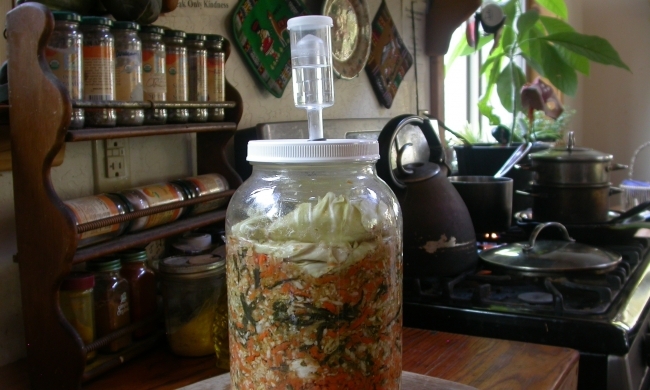
Now place a small jar with a little filtered water on top of the bed of cabbage leaves, this will weight the kraut down and ensure it stays within the juices and brine.
Fill your air tight water seal lid with filtered water to the line and place the lid atop your fermentation jar.
Keep an eye on your kraut for the first couple days and add more water or brine if necessary (all of your veggies should be submerged in the juices, I rarely have to add additional liquids). Your Sauerkraut will be done in approximately one to two weeks (it takes much longer without probiotics).
Kimchi Tips:
Dress up your Sauerkraut with more flavors and it will be Kimchi. My favorite combination is green cabbage, carrots, broccoli, kale, red pepper, onion, garlic, sea palm fronds or hijiki (see veggies), tumeric, Himalayan Sea Salt, and FriendlyForce Probiotics.
Have fun and experiment, often no two kimchi batches will be alike. The diversity of flavors and colors is a delightful addition to your plate.
By adding raw sea veggies to your kimchi you may reduce the amount of sea salt you need to add. Properly made kimchi should still have a crunchy texture.
Other interesting kimchi ingredients include apples slices or juniper berries.
Salt-free or low Salt Sauerkrauts:
"Sauerkraut is possible with little or not salt... Three different methods... One ferments the cabbage in wine. Another substitutes caraway, celery, and dill seeds for the salt, and the third uses seaweed instead of the salt.... salt-free krauts... taste better with salt. By restricting which kinds of organisms can survive in an environment, salt really helps develop sour flavors during fermentation.... If you are trying to consume less salt but are not absolute about no salt, I would suggest adapting these as low-salt variations, with 1 to 2 teaspoons of salt per quart. Salt-free kraut has a shorter lifespan than salted kraut.... Since fermentation goes faster with out salt, be sure to taste salt-free kraut frequently to monitor its progress, and refrigerate it after a week or so." (Katz, 2003, p. 43). Just keep in mind that low/no salt krauts and cultured/probiotic rich krauts ferment quickly.
Hope these tips are helpful. Have fun with this living food experimentation. Lots of Luv, Lisa
Lisa Shelton Rohde, CHC