
Loving Wellness Now
Lisa Shelton

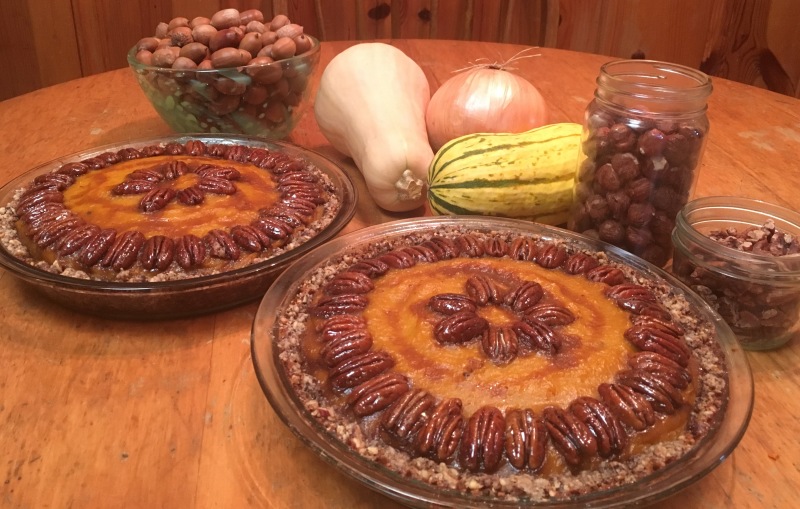
Paleo Inspired and Sprouted Pumpkin Pie


Pumpkin Pies


Paleo Inspired and Sprouted Pumpkin Pie


Pie Crust:
1/2 cup hazelnuts
1 cup pecans
 4 tablespoons melted coconut oil
 pinch of sea salt
 

For this delicious crust I purchase organic and raw hazelnuts and pecans. Soak the raw nuts for 6-12 hours and then sprout them in a jar upside down for an additional 6-12 hours. Your jar should be covered with a screen lid, or a cloth and rubber band will do. Place your upside down jar on a pie tray over a plate to catch the drip. The process of soaking and sprouting enlivens the digestive enzymes, enhances the nutrient bioavailablity, and predigests or breaks down the phytic acids. Phytic acids, are a sort of protective coating on all seeds, nuts, and grains, however, they are not digestible and are in fact an anti-nutrient. An anti-nutrient means it drawn on your reserve of nutrients in order to process it. Preparing your food correctly ensures that you are gaining nutrients rather than spending nutrients. Following the soaking and sprouting process I like to dehydrate my sprouted nuts on a living foods temperature of 105 degrees that will preserve the enzymes and nutrients. Now my sprouted hazelnuts and pecans are ready to create into a Paleo-inspired and sprouted crust for a most delicious pumpkin pie.


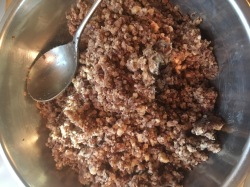
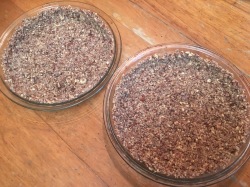
Preheat oven to 350. In a food processor, process the sprouted nuts until they have a grainy consistency. In a small mixing bowl, combine the nut meal, coconut oil and salt and mix into a thick dough. Using your hands, spread evenly into a pie pan and bake for 10 minutes. Add your pie filling and bake for an additional 45 minutes.

Thank you Stephanie Berg for sharing this Paleo-inspired crust recipe with me years ago, it has consistently been a favorite among all who sample in its delight.


Pie Filling:

4 cups cooked organic pumpkin

1/4 cup pure maple syrup or 1 Tbl. black strap molasses

1/2 cup homemade sprouted grain, seed or nut milk of your choice, or store bought coconut milk

4 tsp. coconut oil left on the counter overnight or melted

1 tsp. ground cinnamon

3/4 tsp. ground ginger

1/2 tsp. vanilla oil

1/2 tsp. salt

2 1/2 Tbl. arrowroot powder

1 pie crust

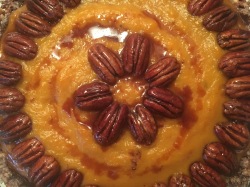
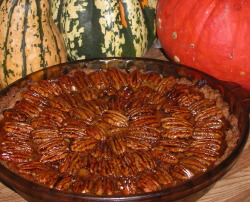
Preheat oven to 350’F.  Precook the pumpkin halves in the oven pumpkin chunks in a steamer.  Remove the skin from the cooked pumpkin.  In a food processor, blend the pumpkin with maple syrup, milk, oil, cinnamon, ginger, vanilla, and salt, until smooth.  Add arrowroot powder and blend some more.  Pour the pumpkin filing into the crust.  Bake for 45 minutes or until it appears firm.  Remove the pie from oven and cover with pecans.  Drizzle black strap molasses over top (optional).  Cook for an additional 20 minutes.  Let the pie cool for several hours or make it ahead of the time and serve it chilled.


Pie Toppings

1 1/2 cups sprouted pecan halves

1 Tbl. black strap molasses (optional)

Toss all ingredients in bowl, mix well, and set aside.  After the pie has cooked for an initial 45 min. or so, decorate the pie with pecans.  Bake for an additional 20 min or thereabouts.


Last but not least - Coconut whipped cream

Can coconut milk, full fat

1 Tbl maple sugar (optional), or 4 drops whole leaf stevia 

1/4 tsp vanilla

Leave a can of full fat coconut milk in the refrigerator overnight.  Place a mixing bowl in the freezer shortly before mixing the cream.  Open the can and separate the oil from the cream (you can save the coconut oil for other recipes). Scoop the coconut cream into the chilled mixing bowl and combine with the maple syrup and vanilla.  Whip the cream with hand mixer or ladle. 


IMG_58461_copy


Crust Meal


Pie Crust


Pie and Filling


Pie Decorated A


Pumpkin Pecan Pie


Lisa Shelton

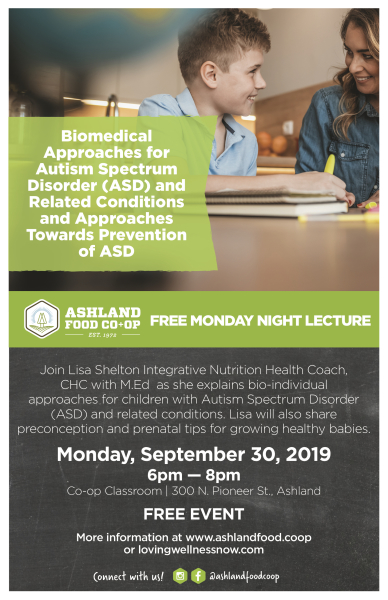
Biomedical Approaches for Autism and Related Conditions

FMNL_Biomedical-ASD_Poster

Lisa Shelton

Nature Batique Decorated Eggs


IMG_2855


To make these special eggs:
1) Boil onion skins (red or yellow) for 5 minutes, then let sit overnight.
2) Wet leaves and stick them to egg, wrap egg in pantyhose and secure with a twist tie.
3) Put wrapped eggs in onion bath, bring to a boil, then reduce heat to simmer for 30 minutes.
4) Remove eggs from onion bath, let cool, unwrap, and that is it (reuse the onion bath dye as many times as you need).


IMG_2853


DSCN3383


Lisa Shelton

Pre-conception and Prenatal Strategies Towards Prevention of Autism Spectrum Disorder (ASD), and Holistic Nutritional Practices for Parenting the Child with ASD.

My long awaited research project on Pre-conception and Prenatal Strategies Towards Prevention of Autism Spectrum Disorder (ASD), and Holistic Nutritional Practices for Parenting the Child with ASD (Shelton, L. 2018) is finally available on Research Gate.  To view my research in its entirety please click VIEW RESEARCH.  You can also view a handout of this research by clicking HANDOUT


135898423

Abstract

Background: Literature review suggests nutritional intake, proper folate utilization, clean environment free of air pollution or toxic exposure, and minimizing stress levels in mothers, are all contributing factors towards a heathy pregnancy and normal child development.  Nutritional intake, avoidance of certain foods, and supplementation are important for children and especially those with ASD.  Dietary elimination of food allergies and food sensitivities, including inflammatory foods, may help to reduce core conditions of ASD in a subpopulation.  Specifically, following a gluten free and casein free (GFCF) diet, and avoiding artificial food colors and additives, may further help to ameliorate conditions in many children on the spectrum.


Objective:  This study examines pre-conception and prenatal strategies towards prevention, or reducing the risk of autism spectrum disorder (ASD) pregnancies, as well as holistic nutritional practices for parenting the child with ASD.


Methods:   Carried out in multiple phases, phase I will study nutritional approaches used for children with ASD, and effectiveness of nutritional approaches in reducing core symptoms of ASD though survey/questionnaire and interview.  Phase II will implement holistic health coaching and nutritional recommendations for future parents, from pre-conception through pregnancy, to support a normally developing child while reducing the risk of a child developing ASD.  Additionally, implementation of nutritional guidance for families with children on the autism spectrum.  Families will be followed for many years.  Pre and post questionnaires and surveys, interviews, chart notes and observations will be analyzed and compared.  All analysis will be combined for interpretation of patterns, what patterns mean, conclusions, recommendations, and next steps.


Results: Results from phase I of this study brought in parent and practitioners responses, 13 respondents representing 15 case study children with ASD reported on the part one survey regarding nutritional approaches.  Of the 15 total, 12 case studies, or 80%, suffered from gastrointestinal (GI) complaints, 10, or 67%, were following specific dietary approaches, however, 11 indicated benefits from dietary approaches.  Case studies generally found multiple behavior benefits from dietary approaches, 10 reported improvements in social reciprocity, 6 reported improvements in nonverbal communication, 7 reported improvements in relationships, 9 reported reduction in restrictive/repetitive behaviors, 9 reported reduction in sensory issues and sensitivities, and 9 reported reduction in GI complaints.  Other benefits reported included remission from epilepsy seizures, increased ability to withstand change, try new things, and be flexible, overall health and wellbeing.  Of the 15 case study children, 14 or 93% report they are utilizing nutritional supplements, and of these, 7 reported improvements in social reciprocity, 5 reported improvements in nonverbal communication, 9 reported improvements in relationships, 6 reported reductions in restrictive/repetitive behaviors, 10 reported reduction in sensory issues and sensitivities, and 7 reported reductions in GI complaints.  Of the 15 case studies, 3 reported having utilized detoxification strategies, and 2 of the 3 indicated benefits from detoxification.  On the questionnaire part two regarding effectiveness of nutritional approaches, 8 respondents representing 9 case study children with ASD reported.  The questionnaire effectiveness scale range was 1 = poor/minimal, 2 = fair, 3 = moderate, 4 = good, and 5 = very/excellent.  Out of 9 case studies, the gluten free casein free (GFCF) diet was rated by 4 case studies, the mean was 2.75, median 3.00, and mode 3.00.  The Feingold diet was rated by 3 case studies, and the mean was 2.67, median 2.00, and mode 2.00.  The gut and psychology syndrome (GAPS) diet was rated by 4 case studies, and the mean, median, and mode were all 2.00.  The allergy free diet was rated by 3 case studies and the mean, median, and mode were all 5.00.  The sugar free diet was rated by 5 case studies, the mean was 3.40, median 3.00, and modes 3.00 and 5.00.  Overall effectiveness of nutritional supplements was rated by 7 case studies, mean 3.29, median 4.0 and mode 4.0.  Vitamin B12 supplements were rated by  4 case studies, and the mean was 3.25, median 3.0, and mode 3.0.  Vitamin B6 were rated  by 4 case studies, the mean was 2.75, median 2.5, and mode 2.0.  Magnesium supplements were rated  by 4 case studies, the mean 2.75, median 2.5, and mode 2.0  Folate was rated by 5 case studies, the mean 3.4, median 3.0, and modes 2.0 and 5.0.  Sulfurophane was rated by 4 case studies, the mean 3.0, median 2.5, and mode 2.0.  Zinc was rated by 5 case studies, the mean 4.0, median 5.0, and mode 5.0.  EPA/DHA omega fatty acids were rated by 7 case studies, the mean 3.86, median 5.0, and mode 5.0.  Probiotics were rated by by 6 case studies, mean 4.67, median 4.5, and mode 5.0.  Enzymes were rated by 3 case studies, the mean, median, and mode were all 5.0.  Multivitamins were rated by 8 case studies, the mean 2.38, median 2.0, and mode 1.0.  Effectiveness of detoxification strategies was rated by 3 case studies, the mean 2.67, median 3.0, and mode 3.0.


Conclusion: Dietary approaches and supplement utilization can have ameliorating effects on some individuals with ASD.  Findings in this phase I study provide additional support for the use of nutritional dietary approaches and supplement utilization for subpopulation treatment of children with ASD recognizing each child’s unique individuality.  It is crucial that replication of this phase I study and future studies combine all survey and questionnaire items into one clickable survey link for consistency of respondents on all questions as this will lead to increased information gathering from respondent reports.  Additionally, this study indicates the importance of further investigation into nutritional approaches and the cumulative and synergistic effects between use of multiple dietary approaches combined with multiple supplements. Individual biomedical approaches are geared towards reducing core conditions of ASD, and shine potential towards prenatal prevention, or reducing the odds, of a child developing autism spectrum disorder.


Lisa Shelton

Nutritional Approaches for Autism Spectrum - Downloadable Handout


Nutritional Approaches for Autism Spectrum - Downloadable Handout

By Lisa Shelton, MEd, CHC, AMC...

135898423

The past couple of years have been an exciting and very busy time for me as I have been devoted to learning, research, and professional growth.  I am expanding my practice of women's, youth, and family wellness to include nutrition and health coaching for children with autism and related disorders and their families.


During the 2017-2018 school year I explored my M.Ed. thesis project examining Preconception and Prenatal Strategies Towards Prevention of Autism Spectrum Disorders (ASD), and Nutrition for Parenting the Child With ASD.  


For a downloadable handout from my thesis research on nutritional approaches for autism, click HERE.  Stay tuned as will make my complete research and study available in the near future.


More recently in January 2019, I completed my study with the Autism Mastery Course (AMC) through the Integrative Medicine Academy, specializing in biomedical approaches for autism, applicable to other neurological, behavior, and learning disorders, and in general chronic health conditions.


As a parent of a child on the spectrum I have experienced first hand the ameliorating effects diet, supplementation, gastrointestinal support, and methylation support in combination with other therapies, can be profound. A healthy child is integral to helping them achieve their full potential.


I am passionate about helping children and their families. Please contact me to schedule a free 15 minute consultation.